
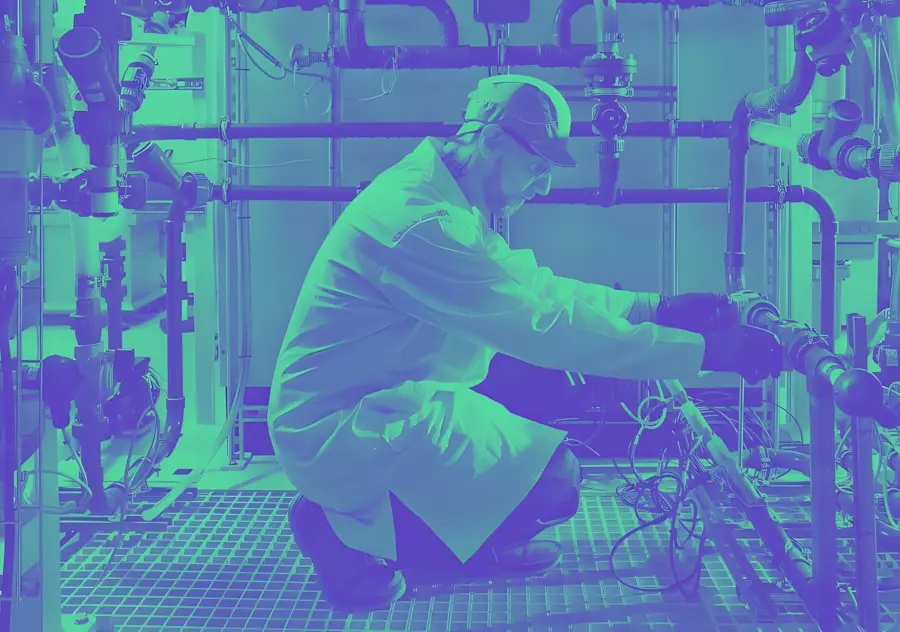
CarbonWorks developed a fully controlled photobioreactor engineered to meet the most demanding production standards. The reactor is designed for axenic culture (the cultivation of microalgae in strictly contaminant-free conditions) and can be fully sterilized to establish and maintain those conditions throughout the production cycle. This level of control makes the technology fully compatible with Good Manufacturing Practice (GMP) requirements, opening the door to pharmaceutical-grade production.
The system supports mixotrophic growth for compatible strains, combining photosynthetic and heterotrophic metabolism to enhance productivity and flexibility. Each strain benefits from a tailored light spectrum, a precise blend of wavelengths optimized to promote either biomass growth or the production of specific metabolites, depending on the target application. Upstream and downstream processes are standardized at industrial scale, ensuring reproducibility and operational efficiency. Total production containment is maintained throughout, guaranteeing both product integrity and environmental safety.
Thanks to a partnership with Fermentalg, CarbonWorks draws on deep expertise in strain improvement to build high-performance biological products tailored to industrial requirements. Through a high-throughput screening and selection platform, strains are improved from microorganisms adapted to their natural ecosystem to robust industrial performers, optimized for productivity, yield, and process resilience.
In the case of pharmaceutical applications, CarbonWorks’ technology also makes it possible to work with genetically modified microalgae designed to produce active molecules or recombinant proteins. One of the advantages of using microalgae as cell factories lies in intracellular compartmentalization: by directing the synthesis of molecules that would otherwise be toxic to the cell toward specific organelles (plastidial transformation), or by enabling certain post-translational modifications (glycosylation) that are not possible with bacteria and yeast.
Microalgal growth relies primarily on photosynthesis, a process that converts CO₂, H₂O, and light energy into biomass. However, not all wavelengths in the visible spectrum contribute equally to this transformation: microalgae preferentially absorb red and blue light, the wavelengths most effective for their photosynthetic pigments. Providing an unsuitable light spectrum therefore end up to consuming energy without efficiently transferring it to the cells, but can also result in less efficient metabolism.
In most conventional photobioreactors, light sources are positioned at the periphery of the vessel (e.g. glass tubes for tubular photobioreactors). Only a fraction of light pass through the reactor wall and diffuse through a dense culture medium, resulting in progressive — and often significant — attenuation before reaching the most distant cells. CarbonWorks has adopted a fundamentally different architecture: luminous modules are immersed directly within the culture medium, drastically reducing the optical path length, resulting in no photon loss through reflection and ensuring a homogeneous distribution of photons throughout the reactor.
To maximise the efficiency of this lighting system, the reactor contents are kept under controlled and efficient agitation. This movement ensures regular and repeated exposure of each cell to the light sources, while also promoting exchanges with dissolved CO₂ — the two essential substrates of photosynthesis. Agitation is therefore designed not merely as a homogenisation mechanism, but as an active lever for productivity without inducing shear stress.
Beyond lighting geometry, CarbonWorks has developed deep expertise in the optimal light profile for each microalgae strain under cultivation: intensity, spectral composition, and exposure kinetics. This knowledge is translated into proprietary industrial lighting modules, engineered to deliver precisely the required parameters at production scale, while remaining compatible with the economic constraints of industrial cost of goods.
It is this combination — immersed lighting, controlled agitation, and precision photobiology — that CarbonWorks refers to as Precision Photosynthesis at industrial scale. It draws on cross-disciplinary expertise in optical engineering, process engineering, and biotechnology, with a concrete objective: for a given quantity of biomass, halving both capital expenditure and electrical energy consumption compared to existing technologies.

Thanks to an anteriority of over 1 billion years, thanks to the fact that they are unicellular organisms, microalgae have a growth and multiplication capacity unique among photosynthetic organisms. And therefore a capacity to produce biomass – and therefore capture CO₂ – far superior to terrestrial plants. For the fastest of them, these microalgae split every 2 to 7 hours in suitable conditions*, and every 24 hours or so for commonly produced strains.
What’s more, these same microalgae have developed strategies for adapting to their environment. To do so, they have learned to produce certain molecules, such as carotenoid pigments that protect the cell from excess light and its deleterious effects on the photosynthetic apparatus, saccharide polymers that form a gangue around the cells and enable them to attach themselves to supports or protect themselves from an unfavorable environment, and temperature-resistant proteins that enable them to live in volcanic environments. Microalgae have also developed the ability to move in an aqueous environment thanks to the flagellum, and to build a protective wall around the cell, which can be of various types, such as silica in diatoms or limestone in coccolithophores.
Using these strategies, for example, microalgae produce 7 to 31 times more lipids than plants under conventional culture conditions.
*: Yu, J., Liberton, M., Cliften, P. et al. Synechococcus elongatus UTEX 2973, a fast growing cyanobacterial chassis for biosynthesis using light and CO₂. Sci Rep 5, 8132 (2015)
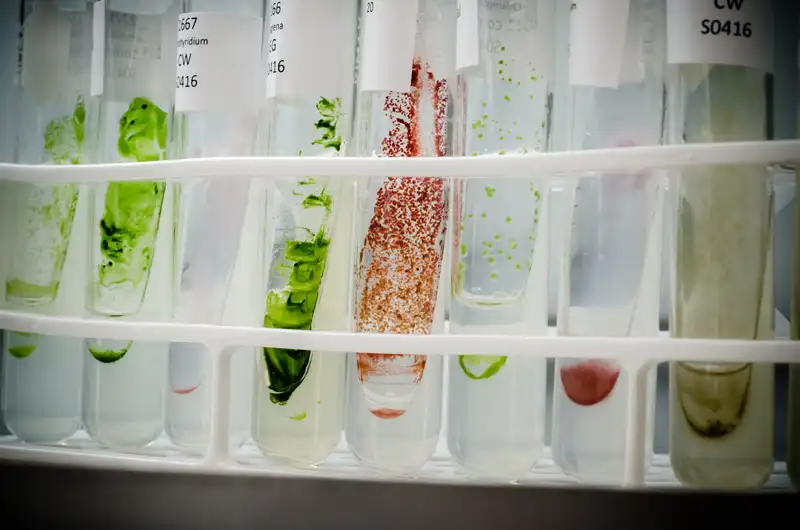
Microalgae are the microorganisms that invented photosynthesis.
This is CCU: By extracting the carbon we all need from CO₂ rather than from underground, CCU avoids the emissions usually associated with the manufacturing of industrial products.